Clear pipe identification turns a complicated plant room into a system people can read. For facilities managers, M&E contractors, maintenance teams and service installers, that clarity supports safer work, faster fault-finding and more consistent handover.
The challenge is not simply to put coloured tape on a pipe. A dependable system starts with verified information: what the service is, where it flows, what hazards apply, and how the marking will remain visible in the real installation. BS 1710 provides a recognised UK technical framework, but it still has to be applied with competent judgement.
What does BS 1710 cover?
The BSI listing for BS 1710:2014 describes a specification for the colours and other information used to identify pipes, ducts and electrical conduits. It is relevant to building designers, operators, users and service installers, as well as industries working with water, waste, liquid fuels, gases and refrigeration.
The standard helps teams create a shared visual language. In practice, that means considering identification colours alongside service wording, flow direction and any other information needed to understand the system. This guide deliberately does not reproduce the standard’s proprietary tables: use an authorised copy and the project specification when defining the final scheme.
Is BS 1710 legally required for every UK pipe?
No. UK legislation does not impose one blanket requirement that every pipe in every workplace must use BS 1710. Duties depend on the hazards, the workplace and the findings of the risk assessment.
There are, however, specific legal requirements that matter. Schedule 1, Part III of the Health and Safety (Safety Signs and Signals) Regulations 1996 includes requirements for labelling visible pipes that contain or transport hazardous substances or mixtures. Where the relevant signs apply, the regulations also address visibility and positioning near dangerous points such as valves and joints and at reasonable intervals.
The HSE’s L64 guidance explains that safety signs are required where significant risk remains after other relevant measures have been put in place. BS 1710 can therefore be a recognised technical specification within a wider safety system, but it does not replace a site-specific risk assessment, approved drawings, contractual requirements or review by a competent person.
The four questions an effective pipe marker should answer
- What does the pipe contain or serve? Use clear, agreed wording that matches the pipe schedule and project records.
- Which way is the service flowing? Arrows should be unambiguous and checked against the installed system.
- Is there a relevant hazard or instruction? Apply required hazard pictograms, warning information and site rules where applicable.
- Can the correct pipe be identified at the point of work? The marker must be visible, legible and placed where an engineer is likely to need it.
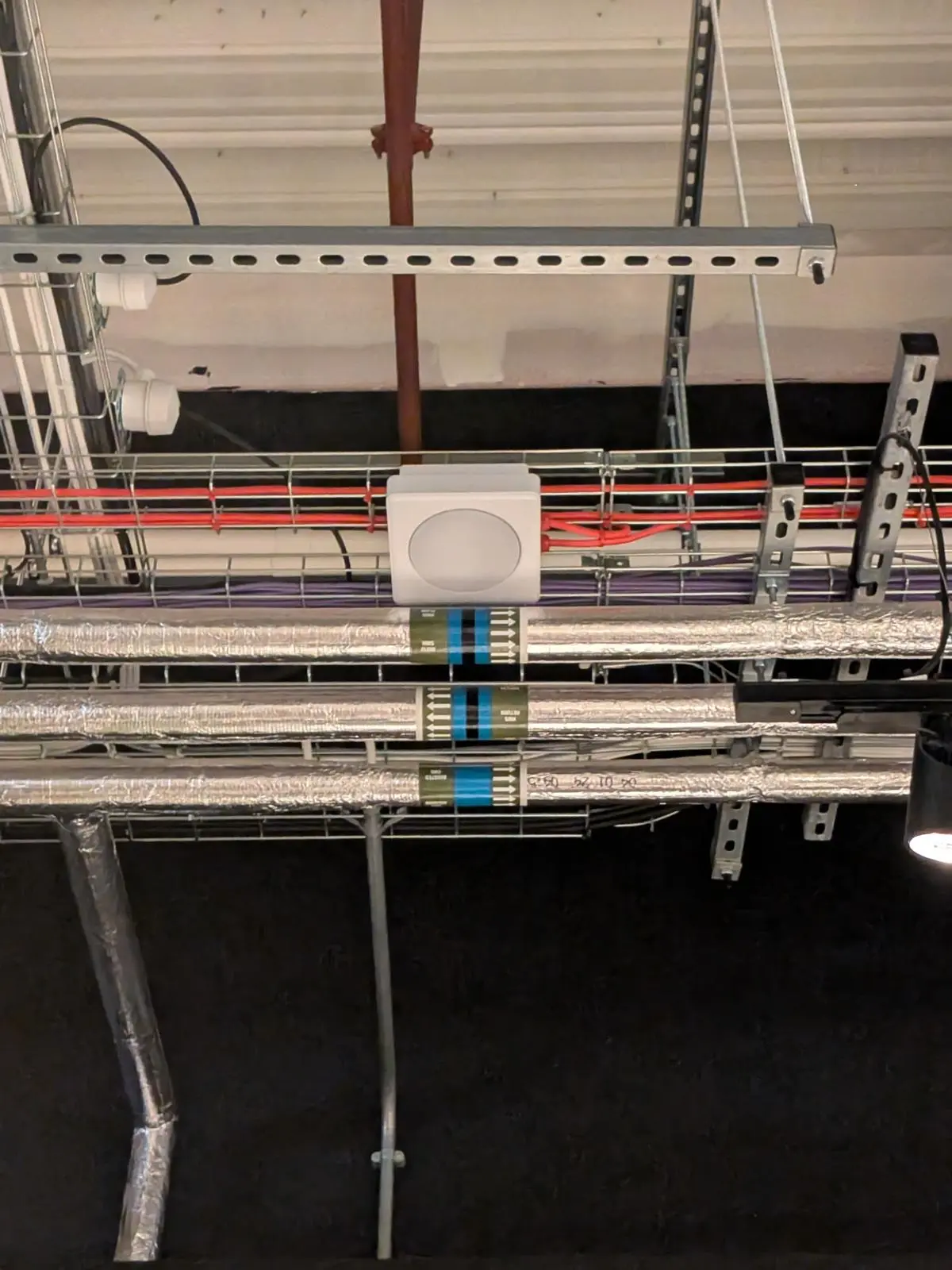
For more examples of installed markers, view the PIPEMARK installation gallery.
A seven-step BS 1710 planning workflow
1. Build and verify the pipe schedule
Start with approved drawings, asset information and the current installation. Resolve conflicting service names, abbreviations and flow directions before ordering markers. Never treat an old label as proof that the underlying information is correct.
2. Review hazards and project requirements
Check the site risk assessment, hazardous-substance information, client specification and any sector-specific obligations. Record who is responsible for technical approval.
3. Define one identification scheme
Use the authorised BS 1710 information and the project specification to agree colours, wording conventions, abbreviations and arrow format. Apply the scheme consistently across plant rooms, risers and service routes.
4. Confirm the message for every marker
Match each marker to the verified schedule. Check spelling, service description and flow direction. If a standard item does not describe the service accurately, review the made-to-order PIPEMARK options rather than forcing a near match.
5. Check the real surface and environment
Inspect the pipe or insulation surface, cleanliness, curvature, condensation, exposure and access. Review the current PIPEMARK product specifications, then confirm that the selected product is suitable for the actual application before ordering.
6. Plan placement before installation
Choose positions that remain visible from normal approaches and working areas. Consider valves, joints, branches, penetrations, changes of direction and reasonable intervals. Do not place markers where brackets, ceilings or future insulation work will hide them.
7. Install, inspect and record
Prepare surfaces in line with the applicable product instructions, install in the agreed orientation and inspect the finished work against the schedule. Update as-built records and include marker condition in routine site inspections.
Common pipe identification mistakes
- Choosing colours before verifying the pipe schedule and applicable standard.
- Copying a legacy marker without checking the service or flow direction.
- Using inconsistent abbreviations between drawings, labels and asset records.
- Installing a single marker where it is hidden from the normal line of sight.
- Ignoring valves, branches, joints, penetrations or changes of direction.
- Selecting a product without checking the surface, environment and installation guidance.
- Assuming BS 1710 alone satisfies every legal, contractual or site requirement.
Frequently asked questions
Is BS 1710 the same as a legal requirement?
No. BS 1710 is a British Standard and recognised technical specification. Legal duties arise from applicable legislation and the circumstances identified by the risk assessment. A project or client specification may also contractually require BS 1710.
Does BS 1710 cover more than pipes?
Yes. BSI’s scope includes identification information for pipes, ducts and electrical conduits.
Where should pipe markers be placed?
Use the approved marking plan and risk assessment. For hazardous substances or mixtures, the safety-sign regulations specifically address visible positioning near dangerous points such as valves and joints and at reasonable intervals. Other services still need a sensible, consistent layout that people can see at the point of work.
Can one marker type be used everywhere?
Do not assume so. Surfaces and environments vary. Check the relevant specification and application conditions, and ask for technical guidance where suitability is uncertain.
More buying and installation queries are covered in the PIPEMARK frequently asked questions.
A consistent system is easier to use and maintain
Good pipe identification is a controlled information process, not a last-minute decorating job. Begin with verified data, apply the standard in context, make markers visible at the points where people need them, and keep the installation aligned with the records.
Plan your PIPEMARK order with confidence
Review the PIPEMARK product specifications, check suitability for the real pipe surface and environment, and send the team your pipe schedule and project requirements before ordering.